
By Larry Kotch, CEO of Flybox
I have seen technically perfect insect farms fail because they underestimated the cost of Black Soldier Fly (BSF) seedlings. It is the most common operational expenditure (OPEX) trap in the industry. You can build the most efficient, climate-controlled rearing facility in the world, but if you are bleeding cash to supply it with neonates, your unit economics will never work. In many business models BSF seedlings account of 50% of costs.
The insect farming industry is maturing, and the days of every farm attempting to master the entire biological lifecycle are ending. The future belongs to those who understand that breeding and rearing are two fundamentally different businesses. Here is the real cost of BSF seedlings, and how to stop them from eating your margins.
The In-House Breeding Trap
The instinct for most new operators is to build an integrated facility. They want to control the entire process, from egg to adult fly. This is a mistake.
Breeding Black Soldier Flies requires precise control over environmental conditions to produce high-quality, synchronized neonates consistently. It demands specialized entomological knowledge, dedicated climate-controlled infrastructure, and rigorous biosecurity protocols. A breeding colony is highly vulnerable to disease, parasites, and contamination, which can wipe out production overnight.
More importantly, the economics of in-house breeding at a small or medium scale are punishing. Scaling breeding is proportionally harder and more capital-intensive than scaling rearing. If you are buying neonates on the open market without a strategic partnership, seedling costs can consume nearly half of your operational budget. The average mass of a neonate is just 16 micrograms [1], yet the infrastructure required to produce them reliably is immense.
The Hub-and-Spoke Solution
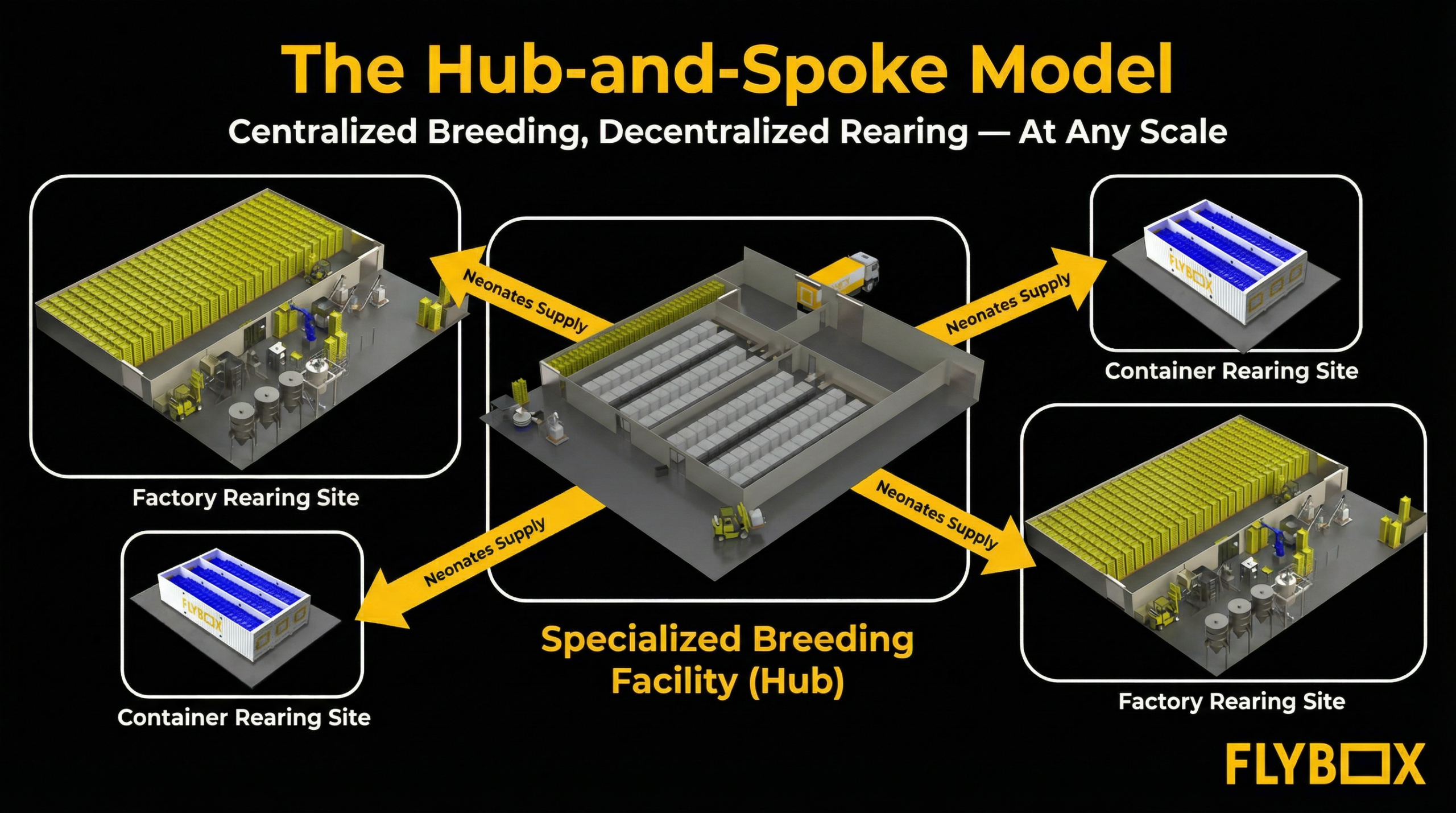
The solution is not to build a better breeding room; the solution is to stop breeding altogether. The industry is moving toward a decentralized, hub-and-spoke model.
In this model, specialized, centralized breeding facilities (the hubs) produce high-quality neonates at scale. These neonates are then distributed to decentralized rearing operations (the spokes), which focus entirely on waste bioconversion and larvae production. Crucially, decentralized does not mean small — the spokes can range from compact container systems to full industrial-scale factory rearing facilities. This is the core thesis behind the Flybox® Fortress System and our strategic partnerships.
For example, in our recent £307,000 deployment, we built a “mini breeder hub” consisting of three breed modules, one hatch module, and one lab module. This facility is designed to supply multiple rearing sites, demonstrating the commercial demand for the full breeding ecosystem. Furthermore, our strategic partnerships with insect breeding companies, de-risks the breeding supply chain for our clients, ensuring a reliable, cost-effective supply of seedlings.
The Economics of Outsourced Neonates
Outsourcing your seedling supply transforms your OPEX profile. It converts a massive, unpredictable capital and operational expense into a predictable, variable cost.
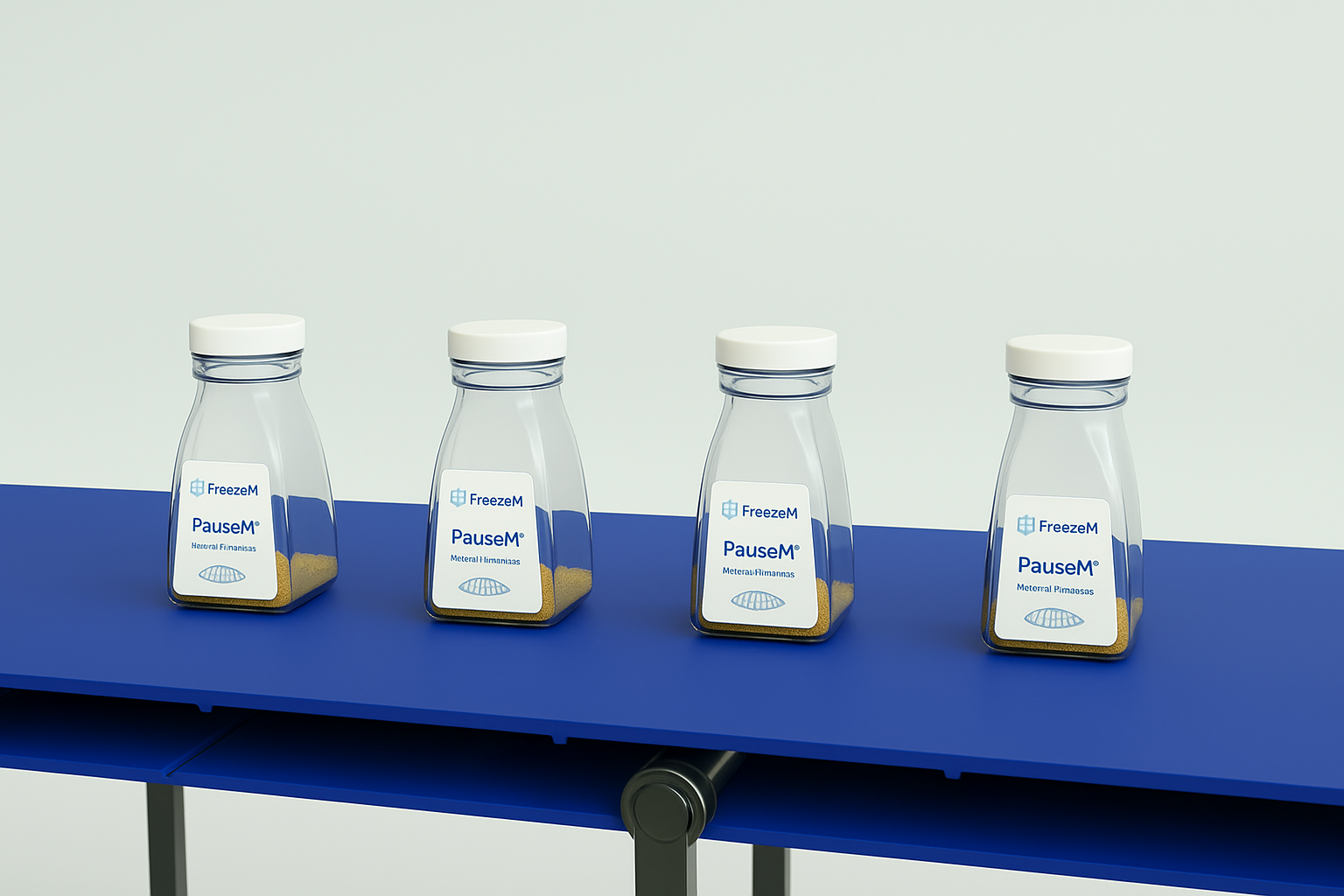
Companies like FreezeM and BSF Breeding are pioneering this space with technologies that provide live-suspended BSF larvae neonates that can be halted for up to 21 days [2]. Each unit contains a synchronized and pre-counted number of neonates, ensuring high consistency and reproducibility between trays. This technology optimizes feed inputs and enhances feed consumption efficiency, addressing the production stability challenge head-on.
By purchasing high-quality neonates from specialized suppliers, farmers can leverage the expertise and resources of professional breeding facilities. This ensures the long-term health and viability of their BSF colonies while allowing them to focus on what actually generates revenue: processing waste and producing protein or frass. This is the foundation of effective Insect Waste Management.
| Breeding Model | CAPEX Requirement | OPEX Predictability | Biosecurity Risk | Best Fit |
|---|---|---|---|---|
| In-House Integrated | Very High | Low (High variability) | High | Massive, well-capitalized commercial facilities (>50 TPD). |
| Outsourced (Hub-and-Spoke) | Low | High (Fixed unit cost) | Low | Decentralized rearing sites, waste managers, new entrants. |
Stop trying to be an entomologist if your goal is waste management. Secure a reliable, subscription-based seedling supply, focus on your bioconversion metrics, and protect your margins.
Suggested Next Step: Are you struggling with your unit economics? Download the Flybox Whitepaper to understand the true cost of Insect Waste Management, or book a feasibility call with our team today to discuss our hub-and-spoke deployment models.
References
[1] Zaalberg, R. M., Nielsen, H. M., Noer, N. K., et al. (2024). A bio-economic model for estimating economic values of important production traits in the black soldier fly (Hermetia illucens). Journal of Insects as Food and Feed, 10(8), 1411-1424. https://brill.com/view/journals/jiff/10/8/article-p1411_8.xml
[2] FreezeM. (n.d.). Breeding Black Soldier Fly Larvae In-House. Top 5 Challenges and Pitfalls. https://www.freezem.com/breeding-black-soldier-fly-larvae-in-house-top-5-challenges-and-pitfalls/