
By Larry Kotch, CEO of Flybox
Most people who ask me about writing an insect farming business plan have a fundamental misunderstanding of the business they are entering. They think they are building a protein factory. They are wrong — and that misconception is why so many projects die before they even start.
I have quoted insect farms in 14 countries, and I see the same mistake repeated globally. Entrepreneurs and waste managers become obsessed with the high-value promise of Black Soldier Fly (BSF) protein, ignoring the brutal unit economics required to produce it. The reality is that insect protein is fundamentally too expensive for its function in many markets. If you are evaluating an insect farming project, you need to understand the difference between the two primary business models: Insect Composting and Insect Protein. Here is exactly how to choose the right path for your insect farming business plan before you spend a penny.
The Protein-First Trap
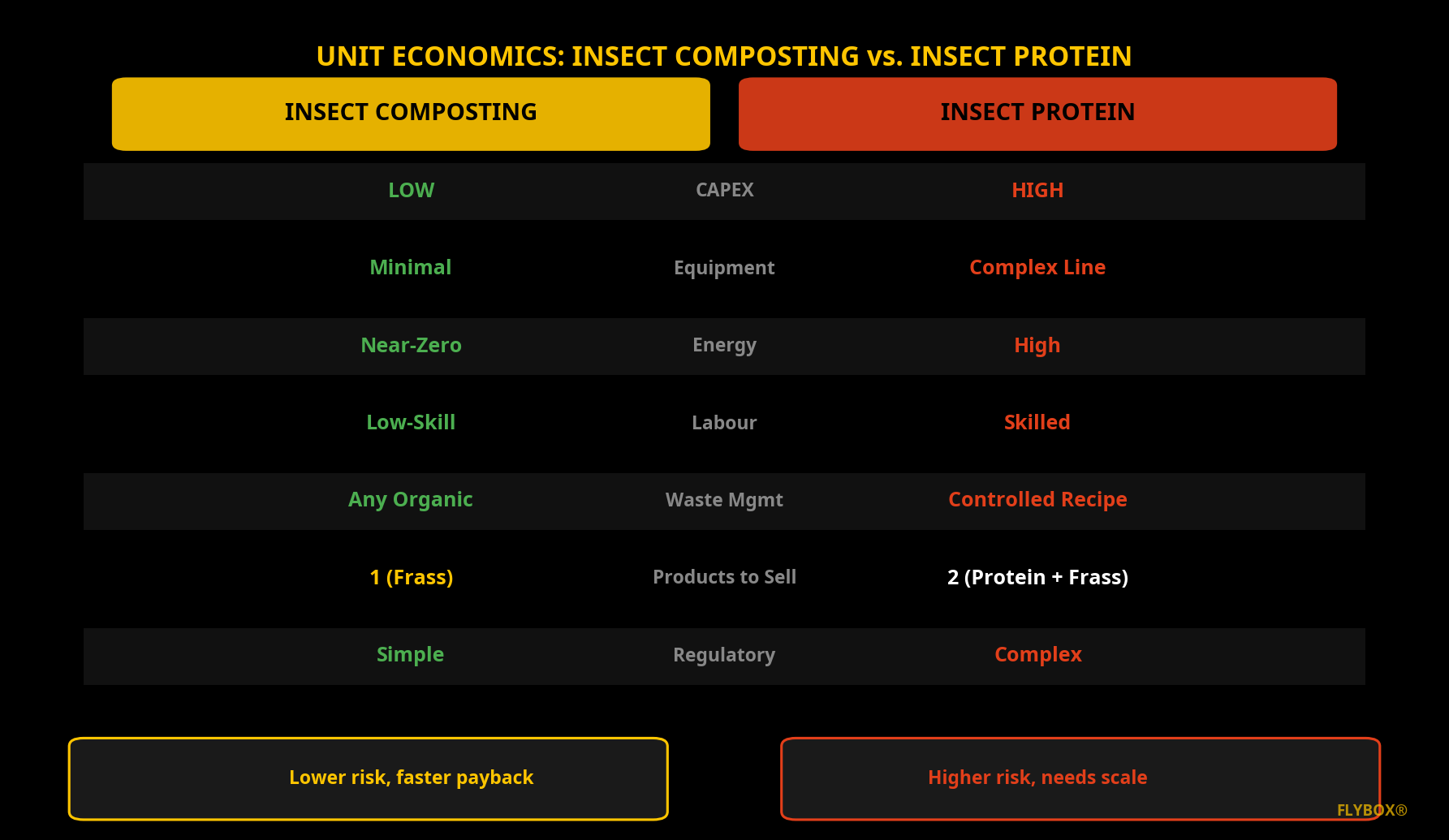
The narrative around insect protein is intoxicating. It promises a circular economy champion that turns waste into high-quality, sustainable feed for aquaculture and poultry. The economics of this model, however, are unforgiving.
A 2024 analysis published in the journal Food and Humanity found that one ton of insect meal costs approximately ten times that of soybean meal. To compete with soy and poultry meal at scale, BSF protein must ideally be priced around $1000 per ton dry weight for mega market access. That is a brutal target.
Here is what the protein-first model actually demands from your operation:
Waste recipe management. You cannot just throw any organic waste at the larvae and expect high protein yields. Protein production requires careful control of the feedstock — the right moisture content, the right nutrient balance, the right particle size. That means pre-processing equipment, quality control, and often a blending operation before the waste even reaches the larvae. Every inconsistency in your waste stream hits your protein yield directly.
More equipment, more complexity. Beyond the growing system itself, protein production requires harvesting, separation, drying, and often defatting equipment. You are running a processing line, not a composting operation. Each additional piece of equipment adds CAPEX, maintenance cost, energy consumption, and points of failure.
Two products to sell. With insect protein, you are now managing two separate sales channels — protein meal and frass. That means two sets of buyers, two sets of quality specifications, two sets of regulatory requirements. Your sales complexity doubles while your margins get squeezed by commodity pricing on the protein side.
Higher labour and energy costs. The monitoring, feeding schedules, harvesting cycles, and processing steps all require more skilled labour and more energy input per tonne of waste processed. Your OPEX climbs fast.
The bottom line for your insect farming business plan: if you choose the protein-first route, you are entering a high-CAPEX, high-OPEX game where you must achieve massive scale to drive down unit costs. You must navigate complex regulatory barriers — novel food and feed regulations vary wildly by jurisdiction — and you must have guaranteed, clean waste streams with established offtake agreements before you break ground.
The Frass-First Reality: Insect Composting

There is an alternative, and it is often the smarter choice for new entrants. We call it Insect Composting.
In this model, the primary goal is not to produce high-grade protein for animal feed. The goal is waste volume reduction and the production of high-value insect compost, known as frass. This approach flips the economic model on its head. Instead of relying on protein sales to cover massive CAPEX, the operation is funded primarily by gate fees — charging to take the waste — with frass sales providing a lucrative secondary revenue stream.
The unit economics are radically different:
Minimal equipment. You strip out the harvesting, separation, drying, and defatting steps entirely. The larvae eat the waste, you collect the frass. The larvae that remain in the residue are a nutrient bonus in the final product, not a separate output to process. Your equipment list shrinks dramatically.
Lower labour requirements. Without the complexity of protein processing, you need fewer skilled operators. Feeding is simpler because you are not optimising for protein yield — you are optimising for waste throughput. A smaller team can manage higher volumes.
Near-zero energy costs. A polytunnel system using natural ventilation and ambient temperature can process up to 30 tonnes of organic waste per day. No climate control, no drying ovens, no mechanical separation. Your energy bill is a fraction of a protein operation.
One product to sell. Frass. That is it. One sales channel, one quality specification, one regulatory pathway. The simplicity is the advantage.
The economics of frass are compelling. Research published in the Journal of Insects as Food and Feed demonstrates that utilising frass fertiliser as an additional value-added product can increase a farmer’s net income by 5 to 15 times compared to BSF farming alone. Maize grown on plots treated with frass yielded 29% to 44% higher net income than maize treated with commercial organic fertiliser.
This model thrives in the Global South — tropical and subtropical climates where ambient temperatures keep the larvae active year-round without any heating costs. Our recent proposals for operations in Togo and Uganda focus entirely on this model: creating superior enriched frass fertiliser with minimal infrastructure.
That said, if your gate fee is high enough and your waste stream is seasonal, insect composting can work in temperate regions for specific cases. A summer-only operation processing agricultural waste during harvest season, for example, can be highly profitable even without year-round production.
Making the Choice
The decision in your insect farming business plan between Insect Composting and Insect Protein should not be based on ambition. It must be based on your specific waste stream, climate, and capital availability.
| Factor | Insect Composting | Insect Protein |
|---|---|---|
| Primary Revenue | Gate fees + enriched frass sales | Protein sales + frass sales |
| CAPEX | Low — simple structures, minimal equipment | High — processing line, drying, separation |
| OPEX | Near-zero energy, low labour | High energy (Depends on location), skilled labour |
| Waste Management | Any organic waste, minimal pre-processing | Controlled recipes, quality feedstock |
| Products to Sell | One (frass) | Two (protein + frass) |
| Regulatory Complexity | Low (fertiliser/waste regulations) | High (novel food/feed regulations) |
| Climate Requirement | Tropical/subtropical ideal; seasonal temperate possible | Any climate with controlled environment |
| Best Fit | Waste managers, municipalities, Global South operators | Well-capitalised operators with clean waste streams and offtake agreements |
Stop guessing at the numbers and the models. Start with the waste, define the output, and build the infrastructure that fits the math. If you try to force a high-CAPEX protein model onto a low-value, inconsistent waste stream, you will join the growing list of failed insect startups.
Suggested Next Step: Are you ready to put real numbers to your project? Download the Flybox Whitepaper to understand the economics of Insect Waste Management, or book a feasibility call with our team today.
References
[1] Undark Magazine. (2026). One of the central challenges facing insect farming is cost. Source
[2] Beesigamukama, D., Mochoge, B., Korir, N., et al. (2022). Economic and ecological values of frass fertiliser from black soldier fly agro-industrial waste processing. Journal of Insects as Food and Feed, 8(3), 245-254. Source